The Income Protection Gap: What Happens to Your Family If You Can't Work Tomorrow
Most Canadians insure their car, their home, and even their phone — but leave their single most valuable asset completely unprotected. That asset is your ability to earn an income. One illness, one accident, one diagnosis changes everything. Here's what the gap looks like, and how to close it before you need it.
A 42-year-old dentist I know — successful practice, beautiful home in Richmond, two kids in private school — suffered a severe hand tremor in the spring of 2023. Idiopathic. Unexplained. One week he was performing 12 procedures a day. The next, he couldn't hold an instrument safely.
He had life insurance. He had a good mortgage. He had no disability insurance.
Within eight months, his practice had been sold at a fraction of its value in a distressed transaction, his family had moved, and his kids had changed schools. His wife returned to full-time work after seven years at home. None of this was because of bad financial decisions. It was because he had left a gap that almost no one talks about openly until it's too late.
This is not an unusual story. It is, in fact, a common one — and the version most people experience is quieter and more gradual, but no less financially devastating.
Your Income Is Your Most Valuable Asset
Consider what your earnings are actually worth over a career. A 40-year-old professional earning $150,000 per year, with modest 2% annual increases, will generate approximately $5.5 million in total income before retirement at 65. A business owner earning $250,000 will generate over $9 million.
Your home — the asset most Canadians feel compelled to protect — is worth, on average, $750,000 to $1.2 million in major Canadian markets. Your income stream, capitalized over a working lifetime, is worth 4 to 10 times that.
Yet the same person who carries comprehensive home insurance, earthquake coverage, and an extended warranty on their appliances will often spend exactly zero dollars protecting the income engine that funds all of it.
The Statistics Nobody Wants to Read
Disability is not a remote risk. The Canadian Life and Health Insurance Association (CLHIA) reports that:
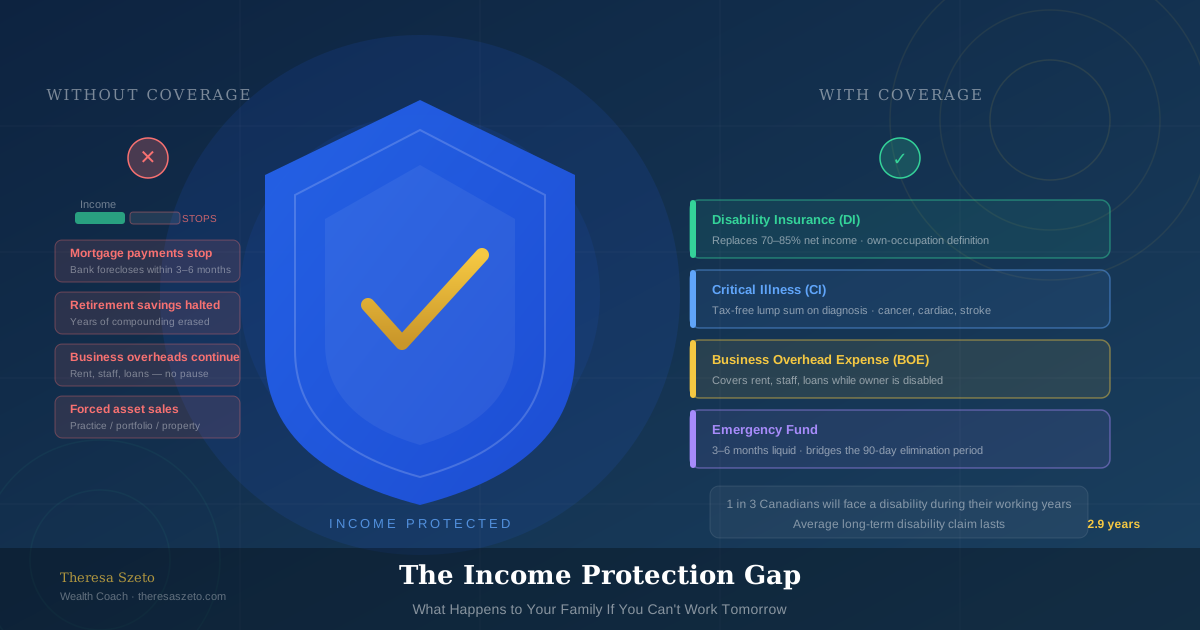
- One in three Canadians will experience a disability lasting more than 90 days during their working years
- The average long-term disability claim lasts 2.9 years
- Nearly half of all mortgage foreclosures in Canada are triggered by a disability, not death
- Cancer, musculoskeletal conditions, and mental health disorders — not accidents — are the leading causes of long-term disability claims
The last point deserves emphasis. Most people, when they picture disability, imagine a dramatic accident. In reality, the leading cause of disability claims is cancer — which strikes one in two Canadians during their lifetime — followed by back and joint disorders, and mental health conditions including depression and anxiety. These are not fringe risks. They are near-certainties over a 25-year career.
Why Group Benefits Are Not Enough
When I raise income protection with clients, the most common response is: "I have coverage through work." This answer carries a false confidence that professional planning must address directly.
Group disability benefits through an employer typically:
- Replace only 60–67% of base salary — meaning a $150,000 earner receives $90,000–$100,000 in benefits. This sounds adequate until you account for the lifestyle, mortgage, and savings commitments built around the full income.
- Are taxable when the employer pays the premium — which means that $90,000 benefit is reduced to approximately $55,000–$65,000 after tax, depending on province. A 45% real replacement rate is the typical outcome.
- Cap benefits at $5,000–$8,000/month — leaving high-income earners with a massive uninsured gap above the cap.
- Use an "any occupation" definition after 24 months — meaning the insurer can cut benefits if you're capable of working in any occupation, even if you cannot return to your specific profession or income level.
- Are not portable — if you leave your employer, change roles, or start a business, the coverage disappears. For people in career transitions — precisely the moments when individual coverage is hardest to qualify for — this gap is especially dangerous.
"Group disability coverage is a floor, not a plan. It was designed to prevent destitution — not to preserve the financial life you've built." — Advisor
The Self-Employed and Business Owner Blind Spot
For incorporated business owners and self-employed professionals, the income protection gap is even more acute — and more complex.
When a self-employed person becomes disabled:
- There is no employer group plan, no EI sickness benefits (unless specifically opted into), and no automatic safety net of any kind
- The business may continue to incur overhead — rent, staff salaries, equipment leases, professional fees — even as revenue collapses
- Business loan personal guarantees remain in effect; the bank does not pause repayment because the owner is ill
- A spouse or partner may need to step back from their own career to manage the family's affairs
This is why Business Overhead Expense (BOE) insurance — a specialized policy that covers the fixed operating costs of a business during an owner's disability — is as essential for incorporated professionals as personal disability coverage. The two products work together: personal DI replaces your personal income, while BOE keeps the business operating and preserves its value until you recover or transition out.
Critical Illness: The Disability Insurance Gap Within the Gap
Even comprehensive disability insurance has a significant limitation: it pays only when you are unable to work. But what about the period immediately following a serious diagnosis — when you technically could work but shouldn't, or when the cost of treatment is the immediate crisis rather than the income loss?
Cancer treatment in Canada, even within our universal healthcare system, involves real out-of-pocket costs that can be staggering:
- Oral chemotherapy drugs not covered by provincial formularies can cost $3,000–$10,000 per month
- Naturopathic and integrative therapies used alongside conventional treatment average $500–$2,000/month
- Travel and accommodation for treatment centres (particularly relevant in rural and suburban communities) can add thousands per month
- Private nursing, home care, and household support during recovery are rarely covered by provincial health plans
- Lost income during the "recovery window" — when you are medically recovered but not yet fully productive — is not covered by most DI policies
Critical Illness insurance addresses this gap directly. It pays a tax-free lump sum — typically $100,000 to $500,000 — upon diagnosis of a covered condition (cancer, heart attack, stroke, and 20+ other conditions in most policies). The money can be used for anything: treatment costs, income replacement, debt repayment, bringing in help at home, or simply giving a family financial breathing room during the worst period of their lives.
For business owners specifically, the lump sum from a Critical Illness policy can fund a temporary management arrangement while the owner recovers — preserving the business value rather than triggering a distressed sale.
The Cost of Waiting to Qualify
The most consistent pattern I see in my practice is people who intend to address their income protection gap but delay acting until a health event makes them uninsurable or significantly more expensive to insure.
Disability and Critical Illness policies are underwritten on your health at the time of application. Common exclusions and ratings arise from:
- Pre-existing back or joint conditions (among the most common disability causes)
- A history of mental health treatment, including anxiety or depression
- Elevated blood pressure, cholesterol, or blood sugar readings
- Family history of certain cancers or cardiac conditions
- BMI outside of standard range
None of these conditions are unusual. All of them — when present at application — result in higher premiums, policy exclusions, or outright decline. The window to qualify at standard rates is open now; it may not be open in five years.
Building a Complete Income Protection Architecture
A complete income protection strategy for a working professional or business owner typically involves several coordinated layers:
- Personal Disability Insurance (DI): Replaces 70–85% of net income (after tax) with a non-cancellable, guaranteed renewable policy. "Own occupation" definition is critical — it ensures you receive benefits if you cannot perform your specific occupation, even if you could theoretically do other work.
- Business Overhead Expense (BOE): For business owners, covers the fixed operating costs of the business during a disability. Premiums are tax-deductible to the corporation or self-employed individual.
- Critical Illness (CI): Provides a tax-free lump sum on diagnosis of a covered condition. Can be structured personally or corporately (corporate CI provides a lump sum that flows to the corporation, which can then pay it out as a tax-free capital dividend in some structures).
- Emergency Fund: Three to six months of fixed expenses held in a liquid account. This covers the elimination period before DI benefits begin (typically 90–120 days) without forcing asset sales.
- Life Insurance (Disability Waiver of Premium): Ensures your life insurance premiums continue to be paid even if you become disabled — preventing a lapse in coverage precisely when your health is most compromised.
The Conversation Most Advisors Skip
In my experience, the income protection conversation is systematically underserved in the Canadian financial advisory space. Disability and Critical Illness coverage are complex to analyze, emotionally difficult to discuss, and less visible than investment performance on a quarterly statement. As a result, clients with excellent investment portfolios and estate plans often carry catastrophic income protection gaps.
The financial consequence of a two-year disability — at a 45% replacement rate — on a $200,000-per-year household is a loss of approximately $220,000 in income compared to expectations. This single event can set back a family's financial plan by a decade.
The cost of adequate individual disability coverage for that same household — typically $300–$600/month depending on age and health — is less than the carrying cost of a car payment.
The math is not complicated. What's complicated is having the conversation before you need it.
If you haven't reviewed your income protection coverage recently — or if you've been meaning to address a gap you know exists — I'd encourage you to treat this as the urgent planning item it actually is. Not eventually. Not at your next renewal. Now.

Advisor
Wealth Coach · Canada's #1 Sales Leader
Advisor has spent 20+ years helping financial professionals and their clients build protection, grow wealth, and create lasting legacies.